


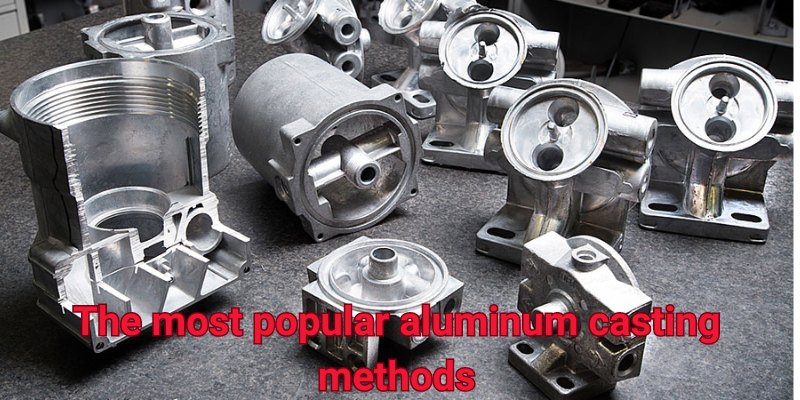
The most popular aluminum casting methods
Aluminum is one of the few metals that can be cast using all of the processes used in metal casting. Each casting process has its own advantages and results in products with different qualities. The article below will summarize the most popular aluminum casting methods and how to choose the right aluminum casting method.
Nội dung bài viết
1. Consideration when choosing aluminum casting technology
There are many factors that affect selection of a casting method for producing a specific aluminum alloy part. The most important factors for all casting processes are:
- Feasibility and cost factors
- Quality factors.
In terms of feasibility, many aluminum alloy castings can be produced by any of the available methods. For a considerable number of castings, however, dimensions or design features automatically determine the best casting method. Because metal molds weigh from 10 to 100 times as much as the castings they are used in producing, most very large cast products are made as sand castings rather than as die or permanent mold castings. Small castings usually are made with metal molds to ensure dimensional accuracy.
Quality factors are also important in the selection of a casting process. When applied to castings, the term quality refers to both degree of soundness (freedom from porosity, cracking, and surface imperfections) and levels of mechanical properties (strength and ductility).
However, it should be kept in mind that in die casting, although cooling rates are very high, air tends to be trapped in the casting, which gives rise to appreciable amounts of porosity at the center. Extensive research has been conducted to find ways of reducing such porosity; however, it is difficult if not impossible to eliminate completely, and die castings often are lower in strength than low-pressure or gravity-fed permanent mold castings, which are more sound in spite of slower cooling.
2. What Are the Different Types of Aluminum Casting Methods?
Aluminum casting methods can be broken down into different types as listed below:
Die Casting
Die casting uses a hardened steel, two-part cavity tool, in which molten aluminum is poured or forced. These tools generally have 100,000 to 150,000 cycles of shot life and produce high-accuracy and high-quality parts. Die casting ranges from using simple tools with hand-poured fill-up to completely automated systems for very high volumes.
Learn more about flow molding technology here
Investment Casting
This process uses a sacrificial positive model of the required part. Before molten aluminum is poured into the plaster form, the wax is vaporized or driven out by baking the plaster tool. The cavity retains its shape and is then filled with molten metal that cools quickly.
In a more up-to-date approach, the positive model used to cast the cavity can be cut from expanded polystyrene, or 3D printed in wax and potentially polymers such as PET and PLA. In the case of plastic “positives”, they must also be burned out of the cavity to leave no residues. This process tends to be reserved for high-value and intricate parts. The tool is destroyed to extract the finished part.
Sand Casting
Sand casting uses a stronger pattern part, generally from wood, and then packs this into two box halves, using sand with a binding agent, and talc as a release and separating agent. Cavities are usually filled by hand pouring, though automation is possible. This is usually referred to as sand casting and is widely employed in the manufacture of lower-volume and/or larger shot-weight castings. While good precision is possible, the destruction of the cavity tool makes this a one-shot process.
Permanent Mold Casting
This process is analogous to die casting in that two permanent (often cast steel) mold halves are clamped together and the cavity filled, generally by hand pouring.
Lost Foam Casting
Lost foam casting is identical to investment casting. The pattern, however, is made from low-density foamed polymer rather than wax.
Shell Mold Casting
A refinement of basic sand casting uses resin-bonded sand cast around the pattern to form a strong shell. Two shells are fixed together to form a sacrificial (single-use) cavity that is filled with molten aluminum. This process makes casting cavities faster and at a lower cost than ordinary sand casting and is used for medium to large casts needing higher precision.
Vacuum Die Casting
Vacuum die casting differs from pressure or gravity die casting in that it uses a reservoir below the casting tool and pulls the molten material up by a vacuum applied to the tool. This results in lower porosity and higher-quality parts and is slowly displacing older die-casting methods.
Ceramic Mold Casting
This process casts a silicate slurry around a pattern and then either burns the volatiles from the slurry (Osborn-Shaw process) or bakes them off (Unicast process), leaving a ceramic cavity into which molten metal can be poured. In many regards, this process is analogous to shell mold casting.
Plaster Mold Casting
This process is similar to shell mold and ceramic mold casting, but gypsum plaster is used to form the cavity tool.
Centrifugal Casting
This process uses a fast-spinning steel cavity tool to cast aluminum. Larger parts with rotational symmetry lend themselves to this process. The tool is spun once filled and centripetal force fills the extremities very cleanly, with no inclusions of porosity. Centrifugally cast aluminum is fine-grained, and defect-free, with improved hardness and strength, compared with other processes. It's used for asymmetrical parts that require the best possible properties and are not cost-sensitive.
Open Mold Casting
Some more primitive casting in aluminum is performed using open cavities made from brick, stone, or steel, or pressed into sand. This is usually a method for producing simple billets for later forge/machining. It can be referred to as a branch of permanent mold casting.
Learn more about the top 6 most popular metal casting technologies today here
3. How to choose the appropriate aluminum casting technology
Complexity of design
The complexity of the design of the final product influences the choice of molding process. Large and complex aluminum casting parts are mostly produced using sand casting, which is preferred for products with complex designs. For precisely sized cast aluminum parts, permanent die casting is the better choice.
Production speed
Molding uses a pressure injection process. Therefore, it is suitable for mass production of aluminum parts. Sand casting is the next process in terms of speed, permanent mold casting comes last.
Bulk
Die casting is the most suitable process for making many aluminum die-cast parts. However, to balance bulk and tooling, sand casting and permanent mold casting are better options.
Prototype
Sand casting is the most suitable process for prototyping due to its low investment costs. Others will require high investment costs, which is not suitable because prototyping only requires a few parts.
Strength and surface finish
Permanent molding offers the most favorable balance of durability and good surface finish. However, die casting and sand casting have similar durability, with die casting having a better surface finish.
Hopefully the above article has provided useful information about popular aluminum casting processes and choosing the right process for your business. If you want to learn more about aluminum casting technology, please contact us immediately to receive advice and quotes!
---------------------------------------------------------------------------------
VIETNAM INDUSTRIAL SERVICES AND SOLUTIONS JOINT STOCK COMPANY
Office Address: B4-12 Vinhomes Gardenia, Ham Nghi, Cau Dien, Nam Tu Liem, Hanoi.
Tel: 0243-7525312 Email: Info@machines.com.vn
Website: www.visgroup.vn



 Phone
Phone
+84-243-7525312
 Mail
Mail
info@machines.com.vn
 Office address
B4 - 12, Vinhomes Gardenia, Ham Nghi Street, Cau Dien Ward, Nam Tu Liem District, Hanoi
PRODUCT
Precision mechanical processing machine
Shearing and press brake machine


INFORMATION
REGISTER TO RECEIVE INFORMATION
Sign up to receive information from VISC