


Process of precision mechanical machining (CNC Machining)

CNC machining is a modern, highly applicable machining method that brings many benefits to industry and production. However, to achieve the best results, we need to have certain knowledge about this processing method. In the article below, let's learn about the CNC machining process.
1. CNC machining process
CNC machining (Computer Numerical Control Machining - CNC) is a manufacturing process in which pre-programmed computer software controls the movement of tools and machines in a factory used to remove a part. workpiece using instructions from the CAD model to create the product. This CNC machining execution process can be used to control a variety of complex machinery, from grinders and lathes to mills and CNC routers. With CNC machining, three-dimensional cutting tasks can be performed with just one set of commands.
2. What are the materials used in CNC machining process?
CNC machining is used on a variety of materials. Each material has its own optimal set of machining parameters (speed and feed) for successful machining of the material. The most common materials are:
Metal
Metal is the most commonly used material in CNC machining. CNC machines can cut almost any type of metal from free-machined brass to nickel super alloys like Inconel. Metalworking covers a wide range of applications from injection molds to shafts and gears.
Plastic
While the majority of plastic parts are produced by injection molding, CNC machining can be used to produce certain plastic parts. Typical materials may include ABS (acrylonitrile butadiene styrene), nylon and polycarbonate. Plastics processing applications can include valve bodies, bushings, and injection molding prototypes to test the overall functionality of the part before investing in expensive molding tools.
Wood
CNC routers are commonly used for cutting wood and are often cheaper than standard metal cutting CNC machines. Wood CNC machining is most commonly done for decorative purposes. Common applications include furniture, window frames and decorative panels.
Foam
Polyurethane foam (closed or open) is commonly used in CNC machining applications. Styrofoam blocks can be cut into tight-fitting packaging for high-value products using a CNC router. One example is the foam used in tool boxes to keep tools safe during transport.
Synthetic materials
CNC machining is frequently used when machining composite parts. Composites can include anything from aramid to fiberglass to carbon fiber. These materials are extremely abrasive to cutting tools. Composite aerospace and marine parts are machined to add fastening holes and for general trimming after the molding process.
3. 4 main steps in the CNC machining process
The CNC machining process includes 4 basic steps. Here's a step-by-step process on how it generally works:
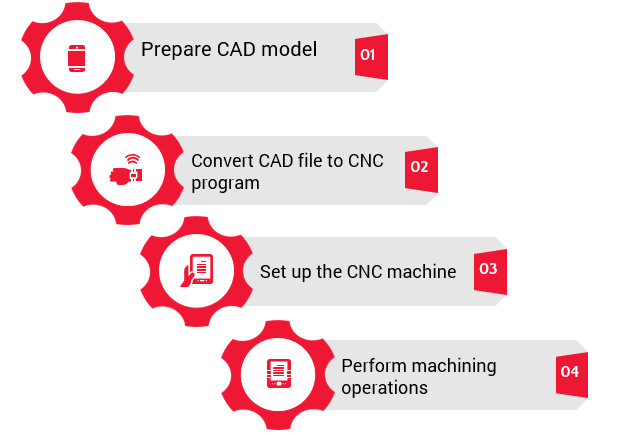
Step 1: Prepare CAD model
This involves creating a 2D or 3D model design of the product. There are many suitable software for this process, the popular ones being AutoCAD and SolidWorks. Furthermore, 2D designs can be converted to 3D designs depending on product requirements.
While some product designs may be simple, preparing some CAD models may require advanced knowledge, especially complex product designs.
The CAD model must be properly designed and easily display to the operator important features such as tolerances, construction lines, threads and other parameters for efficient machining operations.
Step 2: Convert CAD file to CNC program
CNC machines will not understand CAD models. Therefore, you must convert the CAD model to a CNC-compatible format so that the machine can interpret it. For this step, you can use CAM software such as AutoCAD, Fusion 360, or other online software services.
This software can convert to a CNC compatible format and will instruct the CNC machine on the parameters. CAM software is often used by CNC machine operators to generate G-code. At the end of the process, a G-code file is saved to the machine. This file contains all the relevant instructions needed to manufacture that part. Such as rotation and linear motion, cutting sequence, toolpath, workpiece, machine speed, etc., involved in machining operations.
Step 3: Set up the CNC machine
This involves choosing the right type of CNC machine and configuring certain operations before starting the machining operation. Choosing the right machine depends on the workpiece, complexity of the product design, and cost. Preparing the machine to fabricate a new part number begins with setting up the jig needed to hold the raw material in place while the cutting tool removes the material. In addition, the raw workpiece is fixed in the spindle, and fixed cutting tools are inserted into the rotating workpiece to remove material. Necessary tools should be checked for wear or chips and placed in the machine. More advanced CNC machines have automatic tool changers and tool libraries that allow the machine to automatically select the relevant tool needed to machine a specific feature without having to wait for the operator to exchange tools.
Step 4: Perform machining operations
Once the material is securely clamped to the machine, the correct tooling is selected, and the G-code is loaded, the actual machining process can begin. Once the cycle start button is pressed, the machine will select the appropriate tool, move to the workpiece and begin removing material according to G-code instructions and will continue until the part is complete. For operations that require machining with multiple tool types or with parts with multiple orientations, some CNC machines may require the operator to reposition the material being processed between operations. The CNC machining process is automated and will run until the computer program deems it complete. During and after the machining process, machinists will perform several levels of inspection to ensure quality.
Hopefully the information VISC provides from the above article has helped readers clearly understand the CNC machining process and the types of materials suitable for CNC machining. If you need more advice about CNC machining, please contact us.
If you want to learn about and visit CNC processing machines or CNC processing lines, please contact us - Vietnam Industrial Services and Solutions Joint Stock Company (VISC). With over 13 years of experience in consulting and providing solutions in the field of precision mechanical processing, we will provide the most accurate and appropriate advice for your needs.
---------------------------------------------------------------------------------
VIETNAM INDUSTRIAL SERVICES AND SOLUTIONS JOINT STOCK COMPANY
Office Address: B4-12 Vinhomes Gardenia, Ham Nghi, Cau Dien, Nam Tu Liem, Hanoi.
Tel: 0243-7525312 Email: Info@machines.com.vn
Website: www.visgroup.vn



 Phone
Phone
+84-243-7525312
 Mail
Mail
info@machines.com.vn
 Office address
B4 - 12, Vinhomes Gardenia, Ham Nghi Street, Cau Dien Ward, Nam Tu Liem District, Hanoi
PRODUCT
Precision mechanical processing machine
Shearing and press brake machine


INFORMATION
REGISTER TO RECEIVE INFORMATION
Sign up to receive information from VISC