


Sheet metal welding techniques
Sheet metal welding is an important aspect of metal fabrication that helps create products that conform to desired shapes and specifications. There are many different sheet metal welding techniques, but do you know which one is best for your industrial application? This article provides detailed information on the different methods used in sheet metal welding, including their advantages and applications, as well as important tips to keep in mind when welding thin metal sheets to achieve the best results.
1. What is metal welding technique?
Sheet metal welding combines two or more metal components to create a unified structure. This process is important in many different applications, from the construction of buildings and bridges to the production of everyday vehicles, machinery and equipment. By fusing metal pieces, engineers and fabricators can form strong and reliable connections that ensure the integrity and functionality of the final product.
2. Significance of sheet metal welding in modern industries
Sheet metal welding is indispensable in modern industries due to its many advantages
- Strength and durability: Properly joined metal components provide superior strength and durability, ensuring the structural integrity and safety of the final product.
- Recycling and sustainability: Welded and fabricated structures can be easily disassembled, promoting recycling and sustainability across various industries.
- Efficiency and cost savings: Metal joining techniques, when implemented effectively, enable faster production and assembly.
- Flexibility and customization: Metal joints allow for a variety of designs and configurations, meeting the specific requirements of each application.
3. 6 sheet metal welding methods
MIG welding
Metal inert gas (MIG) welding is also known as gas metal arc welding. It involves applying a solid wire electrode continuously into the weld puddle using a welding gun. The molten wire in the tank causes the connection of metal pieces. The shielding gas in the welding gun prevents air contamination of the weld puddle.
MIG welding produces top quality welds and is suitable for most sheet metals, such as aluminum, steel and stainless steel.
This welding method is a technique used in the automotive and home improvement industries. In addition, this is a cost-effective technique because it does not require complex machinery.
TIG welding
Tungsten inert gas (TIG) welding is an arc welding method that involves using a non-consumable tungsten electrode under DC or AC current to create a weld. Like MIG welding, it uses inert shielding gases – argon or helium to prevent atmospheric contaminants and oxidation of the electrode and puddles.
TIG welding is suitable for welding non-ferrous metals such as aluminum, titanium, copper, nickel, magnesium, chromium, etc. This is a valuable technique for the aviation and aerospace industry. In addition, it is ideal for making frames for motorbikes, doors and feeding troughs.
This welding method gives the welder better control resulting in neat and sturdy welds. However, this can be time-consuming and requires the expertise of the welder.
Stick welding
Stick welding is also known as shielded metal arc welding. It is a manual arc welding process that uses a flux-coated rod as the electrode. The current from the welding power source forms an arc between the metal connection pieces and the electrode. It is suitable for hard metals such as iron and steel.
This process does not use any shielding gas. As heat is generated, it decomposes the flux covering the electrode, forming a slag that protects the weld pool from contamination.
This welding technique is perhaps the most convenient because its equipment is compact and portable – easy to carry. This is a popular technique in the construction, shipbuilding and steel manufacturing industries.
Plasma arc welding
Plasma arc welding is similar to TIG welding in that it uses a tungsten electrode. However, it uses a small arc and allows the electrode to be placed on the body of the torch. Pressurized gas forms hot plasma, which melts the metals together to create strong welds. This welding technique requires low energy and operates at high speeds. Furthermore, it produces precise welds making it widely accepted in the aerospace and marine industries.
Like TIG welding, plasma arc welding does not require filler material. Additionally, it produces high-quality welds with less need for finishing.
Electron beam welding and Laser welding
As the names suggest, electron beam welding and laser welding use lasers and electron beams as heat sources to melt and join metal pieces. Unlike most other methods, this welding technique requires complex machinery or automated robots.
This is a high-precision welding technique, suitable for operations with complex details. Laser beams can focus on the smallest materials for extremely high precision welding.
Furthermore, it is suitable for welding hard metals such as carbon steel, titanium, stainless steel and aluminum. This technique is also suitable for thermoplastics. This method results in highly aesthetic products, minimizing the need for post-production.
Welding gas
Gas welding is one of the traditional forms of welding using heat. It involves using heat generated from burning fuel (gasoline), oxygen or oxyacetylene to join pieces of metal together. Burning these fuels creates a very hot flame that melts the metal surface during the joining process.
This technique remains one of the most used welding methods across industries. It has a wide range of applications, suitable for both ferrous and non-ferrous metals. Additionally, it is efficient and effective in welding pipes and ducts, repairing ventilation and air conditioning systems, etc.
Unlike many other welding techniques, it does not require electricity. In addition, it is portable, economical and does not require the services of specialists.
See more arc welding equipment provided by VISC, click here
4. Consider the surface when choosing a sheet metal welding method
Below are the surfaces you may encounter when welding sheet metal and the best methods for using them.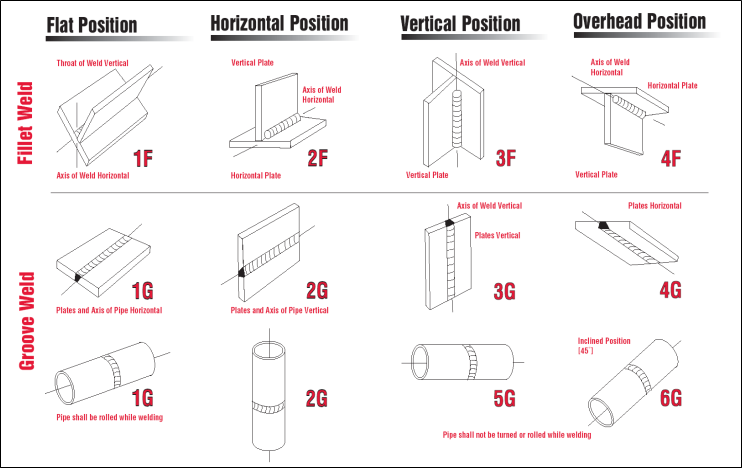
Common weld surfaces
Level surface
Welding a flat surface is called flat welding. The welder approaches this surface from the top of the joint, allowing gravity to assist the melt flow.
To get a good weld on a flat surface, the welder needs to angle the welding head at a 45-degree angle to the metal surface, carefully directing the flame toward the joint.
MIG and TIG welding methods are best suited for flat surfaces. The wire feed and air flow work excellent in a flat setup.
Horizontal surface
In the horizontal configuration, the metal panels appear horizontal to the welder. However, it can exist in two forms.
Fillet weld: Welding that takes place at the upper end of a horizontal surface relative to a vertical surface. The joint area appears to be the junction of two pieces of metal perpendicular to each other in an 'L' shape.
Groove weld: The weld surface is in a vertical plane. Both pieces of metal being joined lie on the same plane.
Stick welding is best suited for working on horizontal surfaces, where it is difficult to get the perfect balance between TIG and MIG welding.
Vertical surface
The vertical position of the welding shaft is basically a welding machine with a vertical surface. Molten metal tends to flow downward and overlap when welding. Therefore, the welder needs to control the flow of metal. This involves pointing the welding gun at a 45-degree angle to the plate and holding the electrode between the flame and the weld puddle.
The best method for vertical surfaces is stick welding. Usually, welders just try to adjust the weld axis to look flat or horizontal for more convenience.
Elevated surface
Welding materials on elevated surfaces is the biggest challenge. As the name suggests, it involves welding a workpiece placed above your head. Molten metal tends to fall off when you try to weld.
To reduce the difficulty of overhead welding, minimize the weld pool. Also, make sure to use enough filler material to get a good weld.
Stick welding is the most suitable method for this configuration. Welding of overhead surfaces is relatively common in custom sheet metal fabrication facilities.
5. 8 tips for metal welding techniques
When fusing metal sheets, the goal is to ensure the welded parts maintain sufficient mechanical properties for the application. Here are some tips to keep in mind as you proceed with welding.
5.1. Choose filler metal
It is essential to use filler metal that matches the mechanical features of your fabrication. The filler must be thinner than the metal sheet. For example, when welding a 1 mm thin metal, 0.6 mm filler is the best choice.
The thinner the wire, the less heat it takes to melt it. As a result, there will be less risk of excessive heat build-up and more chance of getting the best results from your weld.
Additionally, choosing the right filler metal will reduce the risk of rust, cracking, and other possible defects.
5.2. Use bypass welding technique
The bypass welding technique involves using a series of short stitches or welds at key points to hold the thin metal sheet in place. After cooling for a few minutes, the welder can continue welding previously skipped areas.
Skipping the welding process helps avoid metal deformation and warping that often occur due to uneven heat distribution.
In addition, when welding, avoid using the soldering iron; this can also cause excessive heat. Instead, quickly move the torch along a straight path.
5.3. Use stick welding technique
Stick welding is another great technique to reduce the risk of heat buildup and excessive burning.
Nails are small and temporary welds used to hold metal parts together until final welding. To avoid burning holes, keep the metal pieces close together with a gap of 1 mm between them. Then, make small welds until the joint is completely covered.
5.4. Use small wire diameter
When welding with solid wire electrodes, such as MIG welding, be sure to use the smallest diameter wire available. Small wires give the welder better control and a higher chance of correcting errors because they create less residue.
Additionally, the smaller the wire, the less heat it requires to melt. So there is less of a problem with excessive heat.
In general, when working with lightweight sheet metal, 0.023 or 0.024 inch should be used. However, 0.030-inch wire may be ideal when welding 18 garage or thicker metals.
5.5. Use small electrodes
Make sure to use a bar that is less thick than your metal. Use an electrode smaller than ⅛ inch. Smaller electrodes will perform excellently at lower temperatures and currents, thus reducing burn-in and allowing you to grind your electrode to a small area for a tight arc run.
5.6. Clamp the support bar
Clamping the support bar to the work metal allows heat to dissipate faster than simply waiting for it to cool. The back bar draws heat away from the metal, thereby reducing the risk of warping or burning.
Metal bars are usually made of copper or aluminum because they dissipate heat best due to their high thermal conductivity. Make sure the support rod is tightly clamped to the workpiece for adequate heat transfer.
5.7. Use shielding gas with high Argon content
When welding, use protective gas with high argon content. One such example is the typical combination of argon and carbon dioxide in a ratio of 75 to 25, respectively.
Shielding gases with high argon content are preferred because argon gives off less heat. When TIG or MIG welding aluminum metal, you may need to use pure argon as a shielding gas.
5.8. Fit and connect design
Welding thin metal sheets can be difficult. It requires tight and sturdy installation as there are very few flaws. Make sure that the gap between the two joining metals is minimal to avoid burning as the holes can absorb heat.
As a general rule, welders should measure twice and cut once. In some cases, you may need to redesign the joints for greater heat resistance.
Confrontation joints
Butt joints refer to two pieces of metal placed side by side for welding.
The faded surface is the melted area during the welding process. It is important to perform edge preparation on the surface to enhance the strength of the weld. The welder may need to bend one of the sides so they fit tightly together for a strong weld.
Butt welds are relatively easy to prepare and can withstand stress better than other welds. That is why it is the most common weld in fabricated structures. However, there are many other types of welds.
Coupling
The butt joint is a typical variation of the butt joint. They are joints used to weld metal sheets of different thicknesses.
In a joint, two pieces of metal overlap – one is placed on top of the other. The biggest disadvantage of joints is that the connection point of two metals is susceptible to rust.
T-joint
As the name suggests, a T-joint occurs when two pieces of metal intersect perpendicularly, forming a ‘T’ shaped right angle. They are considered a form of fillet weld.
When using this joint, ensure sufficient penetration into the welded roof. You may also need to add a stopper to alleviate common limitations at the connection point. T-joints are common in structures with pipes and pipe systems.
Corner joint
Corner joints are somewhat similar to T-joints in that they both form a perpendicular angle. However, the joining metals have different orientations. In corner joints, the metals meet at the corner, forming a single right angle in an ‘L’ shape. Corner joints are standard manufactured parts, especially frames and boxes.
Edge matching
In edge joints, metal sheets are placed next to each other and welded on the same edge. It occurs in workpieces with crimped edges. The welder may need to bend the edges of one of the two pieces of metal at the appropriate angles so that they fit tightly against the other piece to create a strong weld.
6. Choose suitable sheet metal welding equipment
6.1. Criteria for selecting sheet metal welding equipment
Before choosing to buy metal welding equipment, we need to consider the following factors:
- Requires primary power
- Portability, size and weight
- Welding output and duty cycle
- Electrode selection
- Shielding gas requirements
6.2. VISC is a reputable supplier of sheet metal welding equipment in the Vietnamese market
With a team of experts with more than 20 years of experience in the field of metal welding and cutting, VISC has provided welding equipment and comprehensive welding solution consulting for hundreds of businesses in Vietnam. If you are looking for a suitable welding solution for your business, please contact us immediately for advice and to receive the most preferential quote.
Learn more about the metal welding product lines provided by VISC.
Conclusion
Sheet metal welding techniques are an important aspect of modern manufacturing and construction. Mechanically melting or joining metal components opens up endless possibilities to create sturdy, reliable and innovative structures and products in a variety of industries. Whether it's constructing towering skyscrapers, manufacturing complex machinery, or fabricating artistic metalwork, sheet metal welding continues to shape our world and advance innovation. progress in various sectors of the global economy.
-------------------------------------------------- -------------------------
VIETNAM INDUSTRIAL SERVICES AND SOLUTIONS JOINT STOCK COMPANY
Office Address: B4-12 Vinhomes Gardenia, Ham Nghi, Cau Dien, Nam Tu Liem, Hanoi.
Tel: 0243-7525312 Email: Info@machines.com.vn
Website: www.visgroup.vn



 Phone
Phone
+84-243-7525312
 Mail
Mail
info@machines.com.vn
 Office address
B4 - 12, Vinhomes Gardenia, Ham Nghi Street, Cau Dien Ward, Nam Tu Liem District, Hanoi
PRODUCT
Precision mechanical processing machine
Shearing and press brake machine


INFORMATION
REGISTER TO RECEIVE INFORMATION
Sign up to receive information from VISC