


Sheet metal forming techniques
Sheet metal forming is a manufacturing process that fabricates metal parts from thin sheets of metal. Sheet metal forming is the most cost-effective forming process available today for producing parts in large quantities. It is a flexible, consistent and high-quality process for creating precision metal parts with limited material waste. This article examines the sheet metal forming process, how it works, where it is used, and its benefits and limitations.
1. What is sheet metal forming?
Sheet metal forming, or sheet metal fabrication, is the process of using metal sheets to form sheet metal components. This is achieved by forming and cutting the panels into the required shapes and forms using a variety of processes such as: bending, punching, cutting and hydroforming among others.
Sheet metal forming is extremely popular in manufacturing and sheet metal parts can be found in many applications, such as: automotive industry, aerospace industry, consumer goods and household appliances.
2. What is the purpose of sheet metal forming?
The purpose of sheet metal forming is to create parts made from thin sheet metal for use in a variety of applications. Sheet metal forming is an extremely versatile process that takes advantage of the strength and ductility of sheet metal to create durable parts at a lower cost than comparable manufacturing processes such as forging.
3. How does sheet metal forming work?
Sheet metal forming uses several processes to turn a flat sheet of metal into durable and lightweight metal parts. Bending, shearing, punching, and hydroforming are all examples of processes used to form or cut metal sheets into desired shapes.
The tools for these processes will be set up according to the needs of the design, after which the plate will be processed. Finally, some finishing touches will be applied. This may include: grinding, surface treatment or welding.
4. What thickness of metal is suitable for sheet metal forming?
Sheet metal forming is suitable for metal thicknesses from 0.6 mm to 6.35 mm. This is a general guideline and the actual suitable thickness will vary depending on the type of metal used, the capabilities of the manufacturer and the complexity of the metal part being fabricated.
5. What equipment is used in sheet metal forming?
Sheet metal forming uses a variety of equipment depending on the design of the part and the process applied. Below is a list of some equipment used in sheet metal forming:
Dies are commonly used for cutting and cutting operations whenever holes of a specific shape are needed.
Bending machines are used to perform bending operations.
Rollers are used to shape the panels into conical or cylindrical shapes.
Cutting tools are used to cut in straight lines.
6. What is the sheet metal forming process?
Sheet metal forming involves a number of manufacturing processes, including some basic sheet metal forming operations as follows:
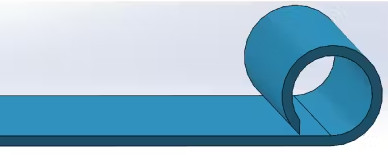
Curling
|
Curling |
Curling is a process of adding a rounded, hollow roll to the edge of a metal sheet. This is done to dull the edges but also to add strength and make the metal panels safer to handle. Metal sheets are often put into specialized machines to roll or gradually bend the edges to form a smooth, round cross-section. Curling is commonly used in HVAC, appliance manufacturing, and architectural applications to create edges on panels, trim panels, or shells. Most metals can undergo bending, depending on their ductility and thickness, including: steel, aluminum and brass. Curling adds strength to the edges of parts and improves stiffness and safety. Complex shapes or tight curls can be difficult to achieve when curling your hair. Depending on the application, specialized tools and machinery may be required to perform curling. |
Refer to the sheet metal cutting machines provided by VISC here
Laser Cutting
|
Laser cutting is a process that uses a high-powered laser to cut shapes into metal sheets. A sheet metal workpiece is securely attached to the laser cutting machine bed. The computer numerical control (CNC) system controls the movement of the laser beam, making precise, clear cuts according to a pre-programmed pattern. Laser cutting is used in applications that require precise shapes, patterns or holes to be cut into metal sheets. It is commonly used in the automotive, aerospace and electronics industries. Laser cutting can be applied on many metals such as: steel, stainless steel, aluminum or copper. Galvanized steel can be cut using laser cutting, but this is not recommended as high temperatures can lead to the protective coating being damaged as well as toxic zinc oxide fumes being released. Laser cutting offers high precision, flexibility and repeatability. Minimal post-processing is required and material waste is minimized. However, initial equipment costs can be high. |
Laser cutting |

Refer to the sheet metal laser cutting machines provided by VISC here
Bending
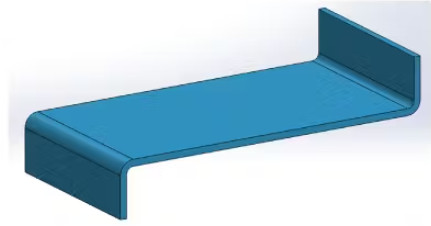
Bending
Bending involves using bending tools to create curves or curves along the straight axis of a metal sheet. Sheet metal bending machines are commonly used, in which the metal is placed or clamped and then bent to the desired angle. Warping is commonly used to make car body parts, shells and electrical components. This process is suitable for most metals commonly used in sheet metal fabrication, such as: stainless steel, brass, aluminum and galvanized steel.
Sheet metal bending is quick, precise, low cost and requires quite simple tools. Some disadvantages include limitations on how thick the metal can be bent, as well as the need for consistent thickness.
Iron
|
|
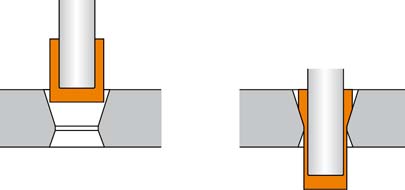
Ironing is a process used to improve the surface finish of sheet metal parts and achieve uniform thickness. A metal part is forced through a die or series of dies that gradually reduce the clearance. By passing through the die, the part's walls are thinned and lengthened without significantly changing the shape. Ironing is used to produce aluminum cans but is also used for other applications that require consistent thickness and a good surface finish. Highly ductile metals are good choices for ironing, including steel and aluminum. Ironing improves dimensional accuracy, surface finish and thickness uniformity in metal parts, but requires specialized tools and machinery. It is also not suitable for parts that require significant shape changes. |
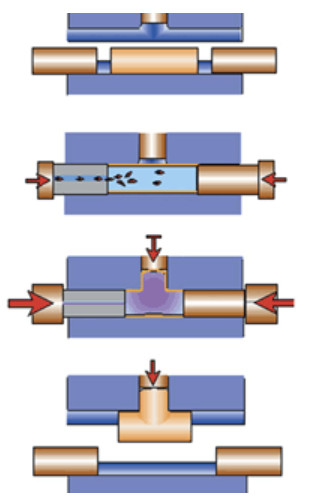
Hydroforming
|
Hydroforming is a process of shaping metal into complex forms using high-pressure fluids. A metal blank is placed in the mold cavity, then high-pressure fluid is injected into the blank, forcing it into the shape of the die. Hydroforming is commonly used in the automotive, medical and aerospace industries, which often require complex shapes. Highly ductile metals are suitable for hydroforming, such as: aluminum, stainless steel and brass. Hydroforming can create complex shapes with uniform wall thickness, reduces waste, and is relatively low cost compared to other forming methods. Disadvantages of hydroforming include the need for specialized equipment, which requires a high initial investment, as well as the expertise needed to perform hydroforming. |
|
Deep drawing
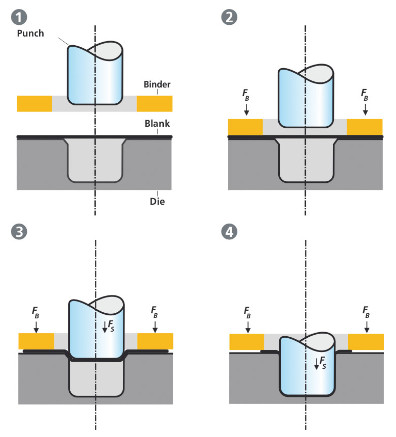
Deep drawing
Deep drawing is a process used to create hollow cylinders, by placing a metal sheet on top of a die and pressing the metal blank into the die cavity using a punch, forming a hollow cylindrical shape without Reduce the thickness of the metal plate.
Deep drawing is used to create containers, beverage cans, and automotive parts such as door panels. This process can be suitable for any metal with high ductility and ductility. Aluminum, stainless steel, copper and brass are commonly used in the deep drawing process.
Deep drawing enables the production of complex hollow shapes with consistent wall thickness and precise dimensions, requiring minimal labor and saving costs at high production volumes.
Shear Cutting
|
|
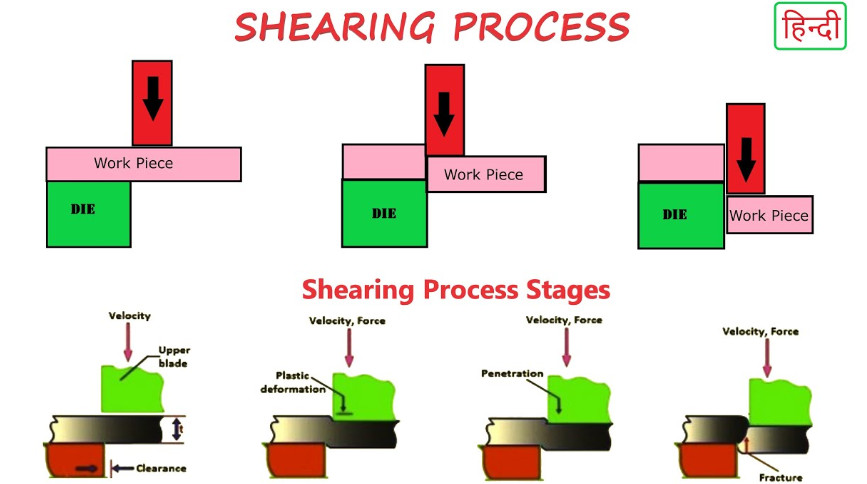
Shear cutting is a cutting process used to cut sheet metal along a straight line. The sheet metal workpiece is placed on a cutting machine that has two blades that slide together to cut the metal. The workpiece is clamped in place and the upper blade of the cutter is lowered onto the workpiece to perform cutting. Shear cutting is used to cut metal sheets into smaller pieces or to trim edges. It is widely used in the manufacturing, construction and automotive industries. Steel, aluminum and stainless steel along with most other metals can be cut. The thickness of the metal and the capabilities of the cutting machine are factors that limit what can be cut. Shear cutting is a quick process that produces minimal waste and is cost-effective at high volumes, but can cause edge distortion and burrs, especially in thicker materials. Cutting only cuts along straight lines and must be combined with other processes to create complex shapes. |
Punching
|
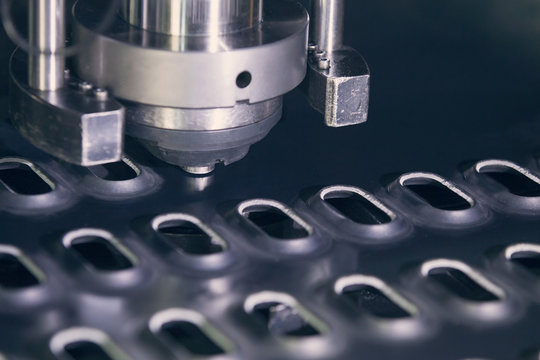
Punching is the process of removing material from a metal sheet to create specific holes, slots, or shapes. The metal plate is placed between the punch and the die. The die supports the metal plate, while the punch is forced through the metal plate into the die to create the hole or shape. Punching is also used to create housings, brackets and panels. Most metals can be used for punching, with the thickness of the sheet and the capabilities of the punching machine being the limiting factors. Punching is a quick, automatic process. It has good repeatability and is a highly efficient process, especially for high-volume production. On the other hand, tooling costs can be high, especially for custom shapes. Some post-processing may also be required, especially for complex designs. |
 |
7. Which materials are suitable for sheet metal forming?
Sheet metal forming can be applied to many different types of metals, depending on the application and the specific properties required from the sheet metal part. Some commonly used metals;
- Stainless steel: Widely used in the medical and food industries. It has high strength, corrosion resistance and good formability.
- Aluminum: Several properties make it ideal for sheet metal forming, including good ductility, corrosion resistance, thermal and electrical conductivity, and excellent strength-to-weight ratio. It is used in applications such as: household and industrial appliances, components for the aerospace industry and in power lines.
- Hot rolled steel: Relatively easy and cheap to produce. It is often used whenever price is more important than accuracy, such as structural parts in the construction industry, automobile chassis parts, and railway tracks.
- Cold rolled steel: Goes through more production stages than hot rolled steel, helping to increase tensile strength. It is commonly used in home appliances, structural parts and the aerospace industry.
Galvanized Steel: Durable metal with good corrosion resistance. It is commonly used in roof structure, air conditioning and refrigeration applications. - Copper: Very malleable, making it a good choice for shaping sheet metal. It has good electrical and thermal conductivity and is commonly used for electrical applications.
- Galvanized steel can be used to form sheet metal. It is often chosen because of its high strength and corrosion resistance as well as its relatively low production costs. Some common applications of galvanized steel parts include: roofing applications, air conditioning, refrigeration, and industrial machinery.
8. Is tool steel suitable for sheet metal forming?
Tool steels are simply not suitable for forming sheet metal. Tool steel is extremely hard and brittle, and it will break if subjected to common metal forming processes. Sheet metal forming depends on the ductility and malleability of metal sheets to form them into metal parts. Tool steels are typically hard with low ductility and ductility. This makes them less than ideal for sheet metal forming.
9. How useful is sheet metal forming?
Sheet metal forming is extremely useful for many applications, as evidenced by how commonly this manufacturing process is used. Sheet metal forming is a relatively low-cost, extremely versatile process that can produce almost an infinite number of parts.
Products created using sheet metal forming can be seen everywhere from beverage cans, home appliances, and metal furniture to HVAC systems and structural parts. and parts for the aerospace industry.
10. Which industries commonly use sheet metal forming?
Sheet metal forming is used in a wide variety of industries due to its versatility, relatively low cost, and durability of the parts produced. Some industries that commonly use sheet metal are:
- Aerospace: Use sheet metal forming due to the overall precision of the forming process, along with the high strength-to-weight ratio of the parts produced. It is commonly used for fuselages and structural parts in aircraft and spacecraft.
- Automotive: Use sheet metal forming for body panels, chassis parts and other structural parts of the vehicle. The durable, lightweight components created by sheet metal forming make this method an ideal choice.
- Construction: Use sheet metal forming to produce durable, weather-resistant parts, such as: roofing, structural parts, and ductwork.
- Medical Devices: Cases and housings for medical devices, as well as medical devices, are often fabricated using sheet metal forming, due to their ability to meet stringent standards and requirements.
- Appliances: Sheet metal forming is commonly used to fabricate housings, frames, and other structural parts used in home appliances due to its versatility, precision, and durability.
11. What are the advantages of sheet metal forming?
Sheet metal forming has a number of advantages and benefits. Here are some advantages of sheet metal forming:
- Relatively inexpensive when compared to other manufacturing processes such as casting or forging.
Very flexible in terms of design and application. Sheet metal can be shaped in many different ways with many different types of metal to create many different parts. - Sheet metal parts are extremely durable, have good tensile strength and environmental resistance.
- Suitable for the production of small batches, ideal for rapid prototyping.
- The use of thin metal sheets makes sheet metal parts light yet durable. This is ideal for applications requiring a high strength-to-weight ratio.
12. What are the disadvantages of sheet metal forming?
Sheet metal forming has several disadvantages. Here are some disadvantages of sheet metal forming:
To start production using sheet metal forming, a high initial investment is required to acquire the necessary equipment and tools.
Very complex designs may not be suitable for sheet metal forming and result in higher costs and production times.
Sheet metal shaping is a fairly labor-intensive process with many manual steps. This can make it slower than other processes such as stamping.
13. Is sheet metal shaping expensive?
Sheet metal forming is relatively inexpensive and is known as a low-cost manufacturing process. Sheet metal forming costs will vary depending on the part's design, the materials used, and the number of processing steps involved. Fabrication costs can be kept low by following fairly simple design elements and using standard dimensions and options.
Conclusion
This article covers sheet metal forming, explaining and discussing how it works and its processes. VISC provides sheet metal processing equipment and lines and high quality machining services. Please contact VISC or visit our website to find out more information or request a quote.
-------------------------------------------------- ------------------------------
VIETNAM INDUSTRIAL SERVICES AND SOLUTIONS JOINT STOCK COMPANY
Office address: B4-12 Vinhomes Gardenia, Ham Nghi, Cau Dien, Nam Tu Liem, Hanoi.
Tel: 0243-7525312 Email: Info@machines.com.vn
Website: www.visgroup.vn



 Phone
Phone
+84-243-7525312
 Mail
Mail
info@machines.com.vn
 Office address
B4 - 12, Vinhomes Gardenia, Ham Nghi Street, Cau Dien Ward, Nam Tu Liem District, Hanoi
PRODUCT
Precision mechanical processing machine
Shearing and press brake machine


INFORMATION
REGISTER TO RECEIVE INFORMATION
Sign up to receive information from VISC