

Robotics integration in automated manufacturing line
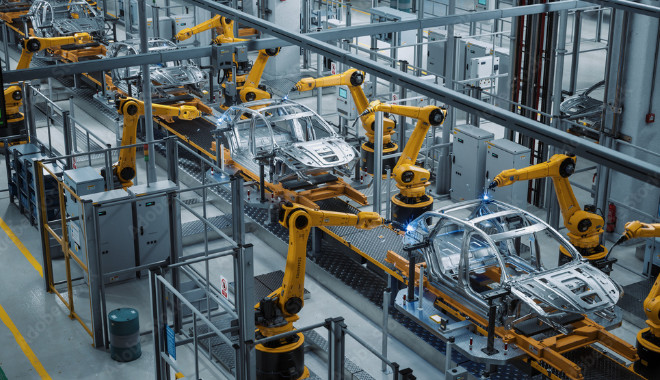
Robotics integration in automated manufacturing line offers countless benefits, of which increased efficiency and productivity are among the most important. So what are the basic components in an automatic production line with robot integration? The article below presents what you need to find out.
1. What is Robotics integration in manufacturing line?
As its name suggests, robotics integration in automated manufatcuring line is in an automation system in an industrial environment in which industrial robots are effectively integrated into a production line to perform multiple tasks. different services in the production process, maximizing automation capabilities.
2. Components of automatic production lines integrate robots
Raw Materials and Materials
Input materials: Are the basic materials used to produce the final product.
Processing materials: Are other components and materials used in the production process.
Lifting and Conveying System
Conveyors and motion systems: Responsible for the movement and transfer of materials and products between different steps on the line. The conveyor system is placed throughout the production line with the task of transporting products through stages, receiving products from one stage to another. Installing a conveyor system changes the method of transportation from manual to automatic, ensuring safety, accuracy, and avoiding errors and damage that manual transportation can cause.
Robots and Automated Machinery
Industrial Robots: Perform a variety of tasks such as assembly, welding, quality inspection, and packaging. Jobs that require human flexibility and precision are gradually being replaced by robots and manipulator systems in production lines. Robots can support and use in stages from processing, production to transportation. With large lines requiring high precision and repeatability, people often use manipulator systems. The manipulator system with flexible rotating joints, receiving control commands from humans, is capable of performing many different complex tasks and movements such as picking up, dropping, installing, and moving. For smaller production lines that require flexibility and compactness, cobots or collaborative robots can be used, allowing them to work and interact with humans.
Cobots: Collaborative robots are integrated to work alongside workers in tasks such as assembly and quality inspection. Benefits of collaborative robots include:
- Collaborative Safety: Cobots are designed to work in close proximity to humans without danger. Safety sensors stop them from working when human presence is detected.
- Flexible and Easy to Program: Cobots are often flexible and easy to program, allowing workers to change their tasks easily without the need for extensive technical knowledge.
- Wide Application: Cobots are used in many industries, from automobile manufacturing, electronics, to healthcare and services.
- Easy Interaction with Humans: Cobots have the ability to interact with humans gently and flexibly. They can work alongside teams of employees or even be programmed to support specific human tasks.
- Automatic machinery: Includes special machinery and equipment to perform specific tasks in the production process without requiring human intervention during operation. May include specialized machinery programmed to perform a variety of tasks in the manufacturing process or other tasks.
Sensor System and Measurement Equipment:
Sensor systems and measuring equipment are an important part of industrial automation and production quality management. This is a set of integrated tools and devices to monitor and measure important parameters in the production process. Below is a detailed explanation of this system:
Sensor:
Function: Sensors are devices that convert environmental information into electronic signals that can be read and processed.
Application: Sensors are used to measure light, temperature, pressure, humidity, distance, color, and many other parameters related to the manufacturing process.
Measuring device:
Function: Measuring devices are tools used to determine the exact values of important parameters in the production process.
For example: Devices such as electronic scales, hardness meters, length meters, gloss meters, dimension meters, and other measuring devices.
Automatic Control System:
Automatic control systems are an important part of industrial and production automation systems. It functions to monitor and control equipment, processes, and systems to ensure that they operate efficiently, accurately, and safely. This system often uses automation equipment and technology such as PLC (Programmable Logic Controllers) and other types of control systems.
Automated control systems play an important role in optimizing performance, reducing costs, and ensuring safety in manufacturing and industrial processes.
3. Benefits of Robotics integration in manufacturing line
Productivity Increase
Integrating robots into a control system offers numerous advantages, with the most notable being enhanced efficiency and productivity. Robots are particularly adept at handling repetitive tasks much faster than humans, resulting in quicker turnaround times and more effective resource utilization. Automation eliminates bottlenecks, shortens cycle times, and boosts overall production capacity, leading to a streamlined manufacturing process that minimizes waste and maximizes productivity.
Quality control
Additionally, robotic integration ensures superior quality control by executing tasks with greater precision and consistency compared to human workers. Robots adhere to strict tolerances, perform quality inspections and measurements, and swiftly identify defects, thus reducing the likelihood of errors and improving product quality. With human error minimized, businesses can produce higher-quality products, leading to better customer satisfaction and an enhanced brand reputation.
Optimal Solution for diversing application
A key feature of this system is its compatibility with a wide range of robotic systems, including articulated robots, cartesian robots, and SCARA robots. This versatility allows for use in diverse industrial applications, enabling real-time motion control, high-speed data transfer, and flexible programming options.
Employing a motion control system to integrate robotics into a manufacturing line ensures optimal matching of all software and hardware components, from the machine’s power supply to cobot-enabled modules. Functions such as robotics, vision, safety, cloud robotics, and machine learning are fully integrated on a single control platform and architecture, allowing direct combination with intelligent transport solutions.
This configuration results in a powerful and comprehensive package with maximum output, leading to extremely compact machine designs with a significantly reduced footprint. All components are fully synchronized, enabling even highly dynamic pick-and-place applications to occur seamlessly.
The latest advances in robotics in advanced manufacturing represent a leap towards a more efficient, flexible and connected manufacturing landscape. Collaborative robots (cobots) redefine the interaction between humans and machines, while robotics integration in manufacturing line streamline engineering workflows, applying flexibility with productivity and quality. high quality. Increased connectivity, precision and adaptability contribute to a manufacturing environment that is not only optimized for efficiency but also positioned for continuous innovation. As robots continue to evolve, their impact on advanced manufacturing will extend beyond individual tasks, shaping the nature of how products are designed, manufactured and distributed to the world.
-------------------------------------------------- ----------------------------------------------
VIETNAM INDUSTRIAL SERVICES AND SOLUTIONS JOINT STOCK COMPANY
Office Address: B4-12 Vinhomes Gardenia, Ham Nghi, Cau Dien, Nam Tu Liem, Hanoi.
Tel: 0243-7525312 Email: Info@machines.com.vn
Website: www.visgroup.vn


 Phone
Phone
+84-243-7525312
 Mail
Mail
info@machines.com.vn
 Office address
B4 - 12, Vinhomes Gardenia, Ham Nghi Street, Cau Dien Ward, Nam Tu Liem District, Hanoi
PRODUCT
Precision mechanical processing machine
Shearing and press brake machine


INFORMATION
REGISTER TO RECEIVE INFORMATION
Sign up to receive information from VISC