


Robotic welding system
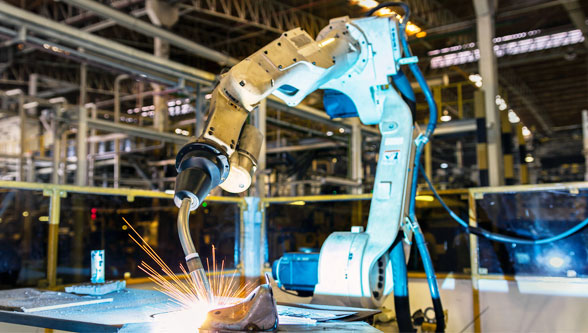
Robotic welding is the process of using automation systems to perform welding jobs. Robotic welding system often bring high investment efficiency, so they are increasingly widely used in modern production. The article below will provide the basics about the automatic robot system and its advantages.
What is Robot welding technology?
Welding robot system is an automatic system that uses industrial robots to perform welding processes in production. Welding robots are often integrated with welding machines or automated welding systems to perform welding tasks on parts or products. Robotic welding systems offer many benefits, including high precision, fast work speeds, and the ability to work continuously without rest.
Benefits of robot welding technology
- Accuracy
Robots are programmed to perform welding processes with high precision, reducing errors and ensuring product quality. - Automation
Robotic welding technology helps automate the production process, reducing dependence on human labor and increasing efficiency. - Flexible Programming
Flexible robot programming system, can be changed quickly to adapt to different models and product types. - System integration
Robotic welding technology is often integrated with other automation systems and quality control systems to optimize production processes. - Increase Performance and Reduce Costs
Automation helps increase production efficiency and reduce labor costs, especially in repetitive and monotonous processes. - Labor Safety
Using robots in the welding process reduces the risk of occupational accidents and improves working conditions for employees. - Automatic Error Detection System
Integrated smart systems help detect and correct errors automatically, reducing machine downtime and ensuring stable production. - Wide applicantion
Robot welding technology is widely applied in many fields such as automobile manufacturing, shipbuilding industry, electronics manufacturing and many other industries.
Overall, robotic welding technology plays an important role in improving production processes, enhancing product quality and optimizing production costs.
Robot welding technologies
There are many different welding methods used in industry to perform the material bonding process. Here are some popular welding methods:
- Spot welding
Spot welding is a type of resistance welding that joins two pieces of metal together at a single point. That's why it's called "spot welding". This process uses a large amount of electric current through the metal to generate enormous amounts of heat. This heat melts the metal allowing the two plates to stick together.
- Arc welding
Arc welding is an old but very popular form of welding. As the name suggests, arc welding uses an electric arc to weld metals together. Like spot welding, electricity is the catalyst for this process. An electric current passes through a metal rod to the material. The metal rod is called the electrode. The current appears as a bright arc. This arc provides the heat needed to melt the two pieces of metal together.
- MIG/MAG welding (Metal Inert Gas/Metal Active Gas)
This method uses welding wire continuously fed into the weld, accompanied by a supply of shielding gas (usually argon or an argon-CO2 gas mixture) to prevent air from affecting the work area. MIG/MAG welding is suitable for many types of metals and has high welding speed.
- TIG welding (Tungsten Inert Gas)
This method uses a non-melting tungsten electrode to create the arc. The base metal and brazing rod are welded at the same time, and it is often necessary to use an air protectant or edargon gas to prevent oxidation.
- Resistance Spot Welding
In resistance welding, two metal patches are placed between two electrodes. When an electric current passes through, a high temperature is created at the contact points between them, causing them to bond together. This method is suitable for fast and effective welding on metal plates.
- Laser welding
Laser welding uses high-intensity lasers to melt and bond metal patches. It provides high precision and can be used for welding small sizes and complex parts.
- Plasma welding
Plasma welding is a welding method that uses plasma energy to melt and bond metals. Plasma energy is generated by ionizing the shielding gas and applying an electromagnetic field.
- Friction Stir Welding
This method uses a rotating press head containing one or more groove segments to restrict the flow of metal. The rotating press head creates high temperature and pressure, causing the metal to melt and bond without the use of preservatives.
Each welding method has its advantages and limitations and is chosen depending on the specific requirements of the manufacturing process and the metal material used.
Welding robot manufacturers
There are many famous welding robot manufacturers in the world, providing high quality welding solutions for many industries. Below are some popular welding robot manufacturers:
- ABB Robotics
ABB is one of the leading manufacturers of industrial robots, and they offer a variety of welding robot solutions for applications in automotive manufacturing, metal processing, and other industries.
- FANUC
FANUC is a company from Japan, specializing in manufacturing industrial robots and CNC machining machines. They offer many different welding robot models for many types of applications. - KUKA Robotics
KUKA is an industrial robot manufacturer based in Germany. They provide automation solutions to many industries, including welding robots for metal and automotive manufacturing. - Yaskawa Motoman
Yaskawa Motoman, a subsidiary of Yaskawa Electric Corporation, focuses on the development and production of industrial robots. They offer a wide range of welding robots to meet the diverse needs of customers. - Panasonic Welding Systems
Panasonic is a famous manufacturer in the field of welding machines and welding robots. They provide quality welding solutions to many industries.
See more welding robot products here
Important Notes when using automatic welding robot system
In robotic welding, the main focus is on software and precise programming. Key costs include equipment, testing and operator training, which is why robotizing the welding process always requires precise planning. The current welded manufacturing process, including all operations and costs, needs to be analyzed. In addition, it is necessary to check the compatibility of the device with the robot.
The specifications must be accurate to ensure proper welding. In automatic welding, the welds are consistent so measurements can be as small as possible. Consistent parts allow the robot to perform welds in the same location over and over again. All processes can be controlled thanks to pre-planned programs to operate the robot.
Robots rely on operator input to perform a given task. However, that task doesn't have to be limited to welding the same part each time because the robot can be reprogrammed. Robots can be made to repeat the same actions around the clock, but the program must be modified as the task changes.
In summary, robotic welding stands as a ground-breaking innovation revolutionising manufacturing by offering unparalleled efficiency and productivity, particularly in large-scale projects. If you are looking for welding solutions for your business, let VISC accompany you. At VISC, we provide robotic equipment with a variety of technologies from reputable manufacturers such as Kuka, ABB, Panasonic, Moka,... along with installation, test running, operation training and maintenance services. Warranty brings satisfaction and trust to customers. Please contact us immediately to receive advice and the most preferential quote.
---------------------------------------------------------------------------------
VIETNAM INDUSTRIAL SERVICES AND SOLUTIONS JOINT STOCK COMPANY
Office Address: B4-12 Vinhomes Gardenia, Ham Nghi, Cau Dien, Nam Tu Liem, Hanoi.
Tel: 0243-7525312 Email: Info@machines.com.vn
Website: www.visgroup.vn



 Phone
Phone
+84-243-7525312
 Mail
Mail
info@machines.com.vn
 Office address
B4 - 12, Vinhomes Gardenia, Ham Nghi Street, Cau Dien Ward, Nam Tu Liem District, Hanoi
PRODUCT
Precision mechanical processing machine
Shearing and press brake machine


INFORMATION
REGISTER TO RECEIVE INFORMATION
Sign up to receive information from VISC