


Collaborative robots: Advantages and selection
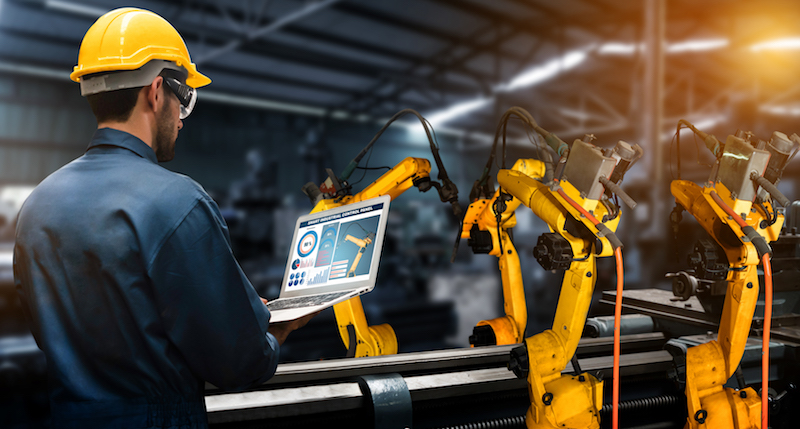
In recent years, productivity in the manufacturing industry has increased steadily. One way to increase productivity is to use work robots (cobots). Cobots or collaborative robots are robots that work with humans in a shared workspace. Therefore, this article will present the advantages and how to choose a working robot (cobot).
What is a collaborative robot?
A collaborative robot, also known as a cobot (acronym for "collaborative robot"), is a type of industrial robot designed to work alongside humans in manufacturing or other work environments in a safe and secure manner. effective. The main difference between working robots and traditional industrial robots is the ability to interact directly with humans during work.
Outstanding features of collaborative robots
Solve labor challenges, increase productivity and enhance competitiveness
Unlike conventional industrial robots that are designed to work independently on heavy tasks and always have protective barriers around them, collaborative robots, also known as co-bots, are the types of robots used. used for the purpose of being able to work together with humans. Like an assistant who supports people with tasks from simple to complex, helping to reduce the time of the process, thereby improving productivity and production quality. In smart factories, collaborative robots are gradually being commonly used.
Operating principle of collaborative robot
Just like industrial robots, collaborative robots operate thanks to their structure with interconnected joints that create degrees of freedom depending on the requirements of the job being used. Movements are calculated and pre-programmed according to the user's intentions to optimize process time and ensure safety for people, products as well as the robot itself.
The camera system and sensors determine position and speed to help collaborative robots easily determine the position in the production line and factory and make safe and optimal movements.
The Pick & Place principle of picking up and putting down helps collaborative robots be applied to most stages from feeding blanks for manufacturing, supplying assembly components, direct assembly or packaging and stacking goods.
Overview of the benefits of collaborative robots
Safety:
Collabarative robots are designed with safety features to reduce the risk of injury in the event of contact with humans. Sensors and safety systems help the robot stop or slow down when it detects human presence.
Cooperation with Humans:
Cobots are programmed to work alongside humans, often in a shared workspace environment. Tasks are performed based on cooperation and interaction between robots and workers.
Flexibility:
Collaborative robots are often flexible and easy to program, allowing tasks to be quickly changed according to production needs.
Wide application:
Cobots are used in many industries, from automobile manufacturing and electronics to healthcare and services. They can perform a variety of tasks, including assembly, packaging, quality inspection, and many other tasks.
Portability:
Many collaborative robots are mobile or integrated into wheeled bases, allowing them to be easily moved to different work locations within the factory.
Sensors and Vision:
Cobots are often equipped with sensors and vision systems to detect the surrounding environment and interact safely with humans.
Collaborative robots have played an important role in the development of industrial automation, helping to optimize production processes and create flexible and safe working environments for humans.
Choosing a collaborative robot
There are several important factors to consider when choosing a collaborative robot for your business. Here are key considerations to guide you through the selection process:
- Matching to the task and application: Start by identifying the specific tasks and applications for which the cobot will be used. Different cobots are designed for various purposes, such as machine maintenance, assembly, packaging or inspection. Assess your operational needs and choose the right cobot for the desired task, payload requirements, and operating environment.
- Safety and compliance features: Safety is the most important factor to consider when deploying cobots in co-working spaces with humans. Evaluate the safety features of cobot systems and ensure that they meet industry standards. Also consider the cobot's ability to safely collaborate with humans, applying safeguards such as speed and force limits.
- Programming and integration: Evaluate the ease of programming and integration with your existing systems. Look for a cobot with a user-friendly interface that allows for intuitive programming and quick task deployment. Compatibility with popular programming languages and software platforms can simplify integration with your production environment, reducing setup time and increasing efficiency.
- Accuracy: It is essential to consider the accuracy required for your applications. Evaluate the cobot's repeatability, positional accuracy, and payload capacity to ensure the cobot can reliably perform the expected tasks.
- Cost and return on investment: Analyze the cost impact and return on investment (ROI) associated with cobot systems. This may include considering the upfront costs of purchasing a cobot and ongoing costs such as maintenance, training and potential system upgrades. Evaluate potential benefits in productivity, labor cost savings, improved quality, and increased operational efficiency to determine ROI over time.
Collaborative robots (cobots) are becoming increasingly useful and highly flexible. This opens up a number of applications and opportunities for automation and can enable safer operations near humans. If cobots are part of that solution, then hopefully this guide will get you one step closer to choosing the right cobot for your application. If you are looking for a robotic automation solution for your business, let VISC accompany you. At VISC, we provide robotic equipment with a variety of technologies from reputable manufacturers such as Kuka, ABB, Panasonic, Moka,... along with installation, test running, operation training and maintenance services. Warranty brings satisfaction and trust to customers. Please contact us immediately to receive advice and the most preferential quote.
---------------------------------------------------------------------------------
VIETNAM INDUSTRIAL SERVICES AND SOLUTIONS JOINT STOCK COMPANY
Office Address: B4-12 Vinhomes Gardenia, Ham Nghi, Cau Dien, Nam Tu Liem, Hanoi.
Tel: 0243-7525312 Email: Info@machines.com.vn
Website: www.visgroup.vn



 Phone
Phone
+84-243-7525312
 Mail
Mail
info@machines.com.vn
 Office address
B4 - 12, Vinhomes Gardenia, Ham Nghi Street, Cau Dien Ward, Nam Tu Liem District, Hanoi
PRODUCT
Precision mechanical processing machine
Shearing and press brake machine


INFORMATION
REGISTER TO RECEIVE INFORMATION
Sign up to receive information from VISC