


10 important criterias to choose the most suitable CNC machine
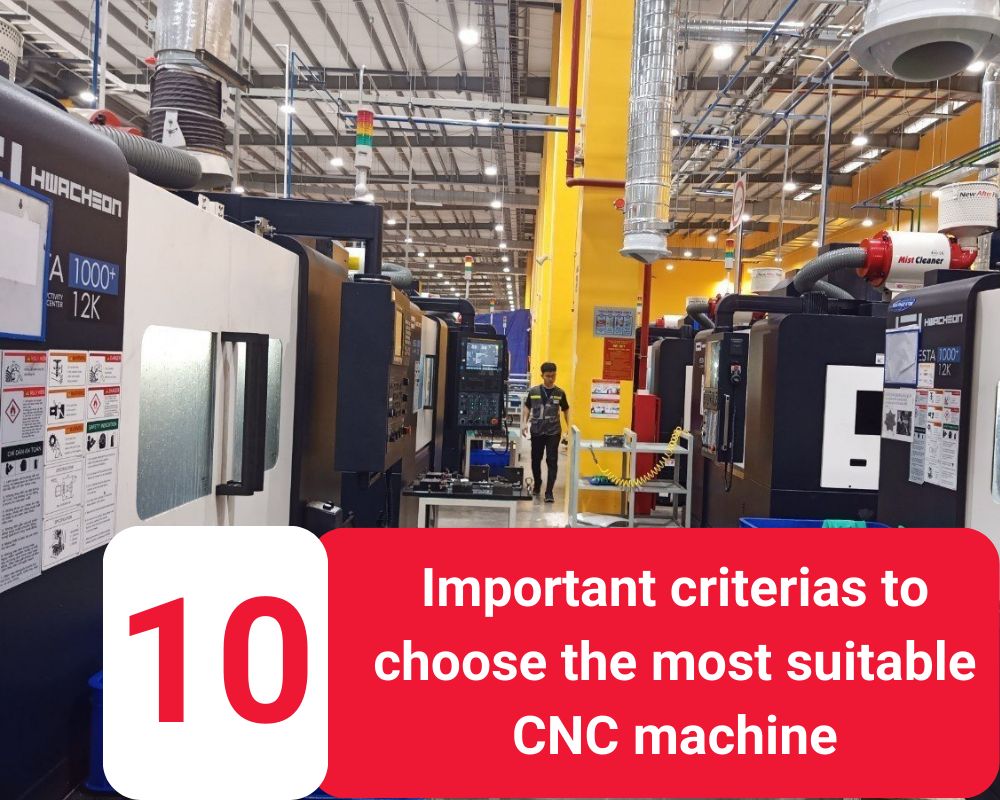
CNC machining machines (CNC machines) are powerful tools that occupy an extremely important position in the precision mechanical processing industry. The diversity of types, sizes, functions, and options from many CNC machine manufacturers gives users countless different choices, but also poses significant difficulties for previous manufacturers. Decide to invest in the CNC machine that best suits your business. So let's learn with VISC about 10 important criterias to choose the most suitable CNC machine to make the smartest decision.
Nội dung bài viết
1. 10 important criteria for choosing the most suitable CNC machine
1.1. Engine capacity
When choosing a CNC machine, consider whether its motor can power the intended task. For example, if you plan to use a CNC router to smooth the edges of wood products, a lower horsepower machine will suffice. Conversely, machines with higher horsepower are more suitable for jobs that require more effort.
Also consider whether the motor's power is provided hydraulically or electrically. Hydraulic motors typically provide more power, durability and efficiency than electric motors. Therefore, they are mainly used in precision CNC grinding machines.
1.2. Type of drive motor used
CNC machines use motors to control movement along or around different axes. The motor must be able to move in the same way each time when given a certain amount of energy. The acceleration and deceleration curves should also be similar. However, not all engines have these characteristics. In this regard, the type of drive motor also needs to be a top consideration when choosing a CNC machine.
There are three types of drive motors: servo motors, stepper motors and hydraulic motors. Hydraulic motors are driven by pumps but are less common. Servo motor has high controllability; it provides predictable speed, power and acceleration curves based on energy input. As the input power increases, this type of motor applies more force or rotates faster. DC-controlled servo motors are the most common type and are popular in heavy-duty machining. Servo motors require adjustment for proper system operation.
Furthermore, they are usually more expensive than stepper motors. However, these factors should only worry you if you are building a CNC machine; If you buy a ready-made CNC machine, the manufacturer has already adjusted the motor.
Finally, as the name suggests, stepper motors move in small steps based on the energy received. This type of motor requires computation because the CPU must coordinate the input power over time, measured in pulses, with the programmed feed rate. The faster the pulses are sent to the motor, the faster the motor rotates. Stepper motors are best suited for woodwork or detail work. That means they're cheaper, easier to understand and work with; Furthermore, they do not require adjustment.
1.3. Material
Two basic but related questions you should ask yourself are: What type of material will you be manufacturing? What you will do? This is because CNC machines are suitable for many different functions. For example, let's say you like wooden furniture; The type of machine you use to mill furniture parts is very different from the type of machine you use to engrave signs. It is clear that wood has significantly different properties than metal. So, if you are looking for a CNC machine best suited for milling or cutting metal, avoid choosing a CNC router. Instead, choose other options such as CNC milling machines, CNC plasma cutters or CNC laser cutters.
1.4. Budget
Different manufacturers cater to different market segments, developing and selling CNC machines at various price points. It is important to note that CNC machines priced under $1000 are not suitable for commercial use. Instead, these machines are designed for hobbyists. So if you need a CNC machine for your business, consider choosing a higher value machine designed for commercial use. Additionally, the price of CNC machines varies depending on the technology used and capabilities. You also need to carefully study this factor.
1.5. Scale, working capacity and production volume
Some CNC machines, especially those designed for mass production of parts, are as large as a small car or SUV. In addition, in some cases, machines such as laser cutting machines require additional equipment such as air compressors, auxiliary air tanks, compressed air dehumidifiers, dust collection systems and specialized air filtration. So, before you choose a CNC machine, consider whether your workshop has enough space to accommodate all this equipment.
And if the factory is large enough, will your production volume be proportionate? Large CNC machines are designed for mass production. So, if you want to choose a CNC machine that can help you iterate on prototypes and create products faster, then a large machine with all the necessary tools is desirable. This is due to their continuous task evaluation. However, size also affects price. Machines with high capacity and fast working speed will have high prices.
On the other hand, if you choose a small sized machine, considering the usable area is equally important. The machine should not be so small that it prevents you from completing tasks or working on certain dimensions. Therefore, when choosing a CNC machine, look for terms such as ''working area'', ''working area'' and ''usable area''. These terms precisely define the area in which the cutting tool can operate.
1.6. CAD/CAM software
Most consumer CNC machines come with a CAD/CAM program included or available as an option. However, you don't need to worry about the program that comes with the device. Most CAM software, such as Fusion, SolidWorks, CATIA, BobCAD, etc., are compatible with most CNC machines.
However, some manufacturers maintain a closed ecosystem, developing proprietary systems for toolpath control. This therefore means you have to learn how to use that software, adding unnecessary steps to the production process. Sometimes, these programs are only accessible by paying a subscription fee. So, when choosing a CNC machine, consider whether it can be operated with third-party software or whether the software is free.
1.7. Cutting or machining technology
Indeed, there are many different types of CNC machines, each using its own cutting or machining technology. As emphasized above, these technologies are suitable for different materials and produce different results. Additionally, some cutting machines, such as CNC waterjet cutting machines, can be used not only to cut materials but also to strip paint and prepare surfaces. Others, like CNC mills, can be used for drilling, reaming, and metal shaping, while CNC lathes can be used for threading, boring, reaming, reaming, and surface machining. Therefore, you should consider machining technology because it opens you up to many other operations besides cutting.
1.8. Control method (PC control or manual control)
Some CNC machines are manually controlled machines. This means the user is responsible for manually controlling the machine when making cuts. However, these machines have smart features that can compensate for human errors. For example, make real-time adjustments to ensure clean cuts. Additionally, if you drive off the programmed path, the machine's main shaft will automatically retract safely.
On the other hand for other CNC machines: cutting tools and their movements are 100% controlled through the control system on the user's personal computer or through software installed on the machine itself. The second type works without a PC connection. But this convenience means that CNC machines are often more expensive than PC-based machines. This is because they have a built-in computer and storage to handle computational tasks.
1.9. Online forum
Like all other mechanical components and software, CNC machines and systems can sometimes experience problems and complications. Luckily, reputable manufacturers have online forums that allow users to share experiences, ask questions, and get questions answered. These online communities are a valuable resource for gathering real user opinions, which can help you compare machines. Additionally, they can help you become familiar with the machine's operation.
1.10. Operator skill level
CNC machines operate quite differently, meaning operators must learn how each machine works. Knowledge gained from working with a particular type of CNC machine may not be applicable to another type of machine, especially if it is made by a different manufacturer. However, to solve this problem, machinists can use the same universal CNC controller for each machine.
Manufacturers such as Fanuc sell a variety of CNC control systems. The product line includes systems for standard machining applications up to those capable of handling the most complex machining processes. These systems are compatible with CNC machines produced by other manufacturers. Therefore, you may consider purchasing a multi-function CNC control system.
2. Compare and choose CNC machine suppliers
After considering the factors above, you may have come up with a list of suppliers that meet your requirements. Then you need to continue comparing based on the 6 criteria below to choose the most suitable CNC machine supplier:
2.1. Research and compare different suppliers and products
To stay ahead of the competition, these manufacturers promise a variety of offerings, including after-sales services, features, and tools. So if you rush into choosing a supplier, you may end up finding that you've got a raw deal. Therefore, we recommend that you do extensive research, using both online and offline resources. Next, make a complete list of different CNC machine suppliers and their products. Using this list, you will then be able to compare these manufacturers and what they offer.
2.2. Evaluate vendor support and training
A simple look at the websites of different CNC machine suppliers reveals clear differences: they have different approaches to providing support and training. For example, most offer learning materials in the form of in-depth training classes and courses in metalworking or woodworking, how-to resources, project ideas, step-by-step explanations of CNC machine capabilities (product training) and more.
At the same time, the providers offer completely different support. For example, most of their support teams typically include field technicians (factory-trained employees) who have first-hand experience and can help customers with any service needs. . This approach allows them to troubleshoot problems through phone calls without having to send in a technician. The result is minimal downtime, especially since these individuals are available 24/7.
However, you may be surprised to find that some providers don't offer vendor services – at least, that's what we gathered by taking a close look at their websites. (However, we cannot name names.) For this reason, it is important to choose a CNC machine supplier that promises 24/7 support. After all, mechanical equipment is bound to fail at some point during its lifetime.
2.3. Check customer reviews and references
As a business operator or owner, you probably know a number of other businesses operating in your specific field. And even if not, you can always create a relationship by reaching out and asking about their preferred CNC machines. Armed with such information, you can easily choose a CNC machine over another. Additionally, you can look through customer reviews on social networks or specialized review sites. However, reviews are difficult to come by because industrial-grade machines are rarely sold online, requiring direct contact with the manufacturer or supplier.
2.4. Learn through online forums
Online forums are convenient platforms where customers share their experiences about manufacturers' CNC machines. They also ask questions about problems encountered during use, expecting answers from other users or company representatives. So these online forums maintained by manufacturers are ideal for gathering data about machines with problems. This way, you can identify what to avoid, which will help you narrow your search.
2.5. Evaluate after-sales service
Some CNC machine suppliers operate on the premise that each customer's needs are different. Therefore, they tailor their after-sales services to suit these specific needs. As such, they offer predictive, preventive and reactive maintenance as well as a full catalog of OEM parts.
Preventive maintenance involves performing scheduled maintenance after a certain number of hours or months. Predictive maintenance entails remotely monitoring the health of your equipment to determine when the supplier should schedule maintenance. This approach predicts problems before they can lead to downtime. Finally, reactive maintenance involves scheduling repairs immediately after equipment failure, with the work performed by local OEM-trained service engineers.
Some providers offer only some of these services, while others offer them all. However, the latter depends on choosing and paying for a maintenance package that contains all of these services. So, if you want to enjoy all these perks, choose a CNC provider that is committed to these services and sign up for the service.
2.6. Negotiate reasonable prices and warranty terms
Once you've got a few viable options of equal quality and caliber, it's time to make a purchase. Contact suppliers and negotiate reasonable prices and warranty terms.
3. The most reputable address to choose to buy CNC machines on the market today
Vietnam Industrial Services and Solutions Joint Stock Company with 13 years of experience in the field of precision mechanical processing, specializes in providing CNC processing line products combining automation and robots. With a team of experienced engineers who are experts in the field of machining, we are proud to have successfully established many automation processing lines for large manufacturing factories in Vietnam. VISC has gradually established its position Leading position in the mechanical and automation industry, trusted by customers and partners. We are also the only representative in Vietnam of the Korean Hwacheon Machinery company, specializing in manufacturing high quality processing machines. In addition, VISC also distributes CNC machines from JTEK, Fanuc, Mitsubishi,...
We are confident that with our deep understanding of the industry and practical experience, we will find the solution and equipment that best suits your processing requirements. In addition, VISC has a factory equipped with modern CNC machining machines for you to visit and learn about.
So, if you have a need for processing machines, please contact us for advice.
-------------------------------------------------- ------------------------------
VIETNAM INDUSTRIAL SERVICES AND SOLUTIONS JOINT STOCK COMPANY
Office Address: B4-12 Vinhomes Gardenia, Ham Nghi, Cau Dien, Nam Tu Liem, Hanoi.
Tel: 0243-7525312 Email: Info@machines.com.vn
Website: www.visgroup.vn



 Phone
Phone
+84-243-7525312
 Mail
Mail
info@machines.com.vn
 Office address
B4 - 12, Vinhomes Gardenia, Ham Nghi Street, Cau Dien Ward, Nam Tu Liem District, Hanoi
PRODUCT
Precision mechanical processing machine
Shearing and press brake machine


INFORMATION
REGISTER TO RECEIVE INFORMATION
Sign up to receive information from VISC