


Automated assembly technology for consumer products
In today's industry, automated assembly technology is becoming an undeniable trend in the production of consumer products. Developed from automation systems, automated assembly technology helps increase productivity, quality and homogenize the production process.
1. What is an automated assembly line in Manufacturing?
Automated assembly line involves the sequential assembly of a product at a number of work stations, each performing a specific task or operation. The assembled product moves along a conveyor or production line until it is completed.
Automated assembly technology uses automated systems to perform the various steps involved in the assembly process. These systems use advanced automation technology, including control systems, interfaces, modules, feeders, AGVs (Autonomous Guided Vehicles) and collaborative robots, to streamline production and ensure maximum efficiency.
2.How does automated assembly work?
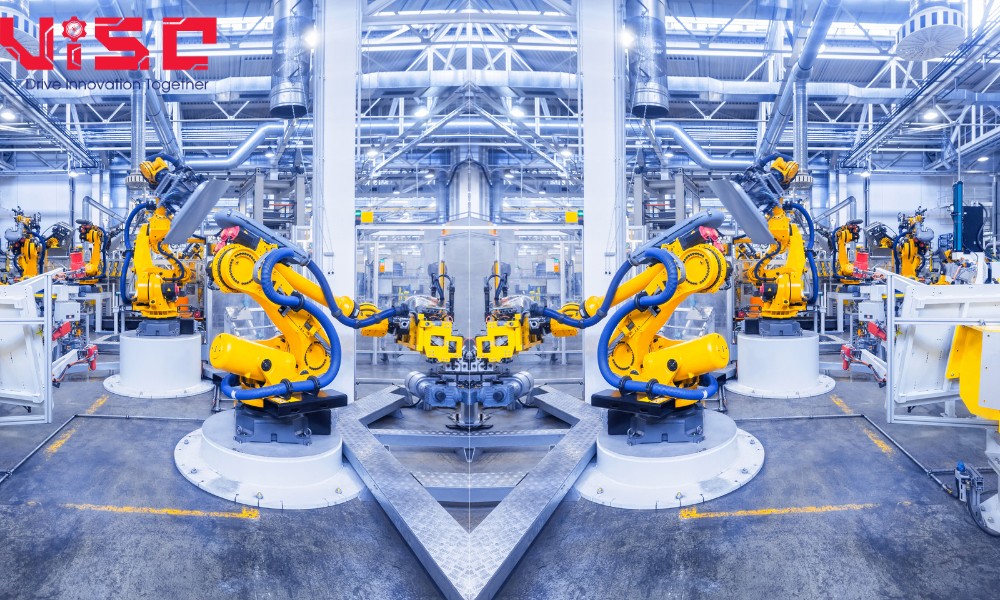
Automated assembly lines typically consist of a series of work stations connected by conveyors or pallets. Raw materials or components are fed into the production line at one end and finished products are delivered at the other end. Each workstation is designed to perform a specific task, such as assembly, inspection, testing or packaging.
The control system is the brain of the automatic assembly line, controlling the operating sequence and monitoring the production process. Collaborative robots or "cobots" work alongside humans to perform tasks that are dangerous, repetitive, or require high precision. Machine vision technology detects errors, ensuring the final product meets quality standards.
3. Application

The automated assembly line system revolutionized production by dividing labor into manageable, repetitive tasks, significantly speeding up manufacturing.
- Automotive Industry: Assembly lines are crucial in car manufacturing, with tasks divided among workers and machines. For example, one station might install the engine, while the next fits the wheels, significantly increasing daily vehicle production.
- Electronics: In electronics manufacturing, assembly lines manage the intricate assembly of small, precise components, from smartphones to household appliances, ensuring high accuracy and efficiency.
- Large-Scale Production: Industries like furniture, clothing, and food processing use assembly lines. Each segment handles a specific task contributing to the final product, allowing for mass production under stringent quality control measures.
Automated assembly lines further enhance efficiency and reduce human labor, especially in complex manufacturing environments like the automotive and electronics industries.
4. Benefits of Automatedssembly Line
Automated assembly lines offers several benefits:
- Improved Efficiency: Automated lines operate at high speeds, reducing cycle time and increasing throughput, which boosts productivity, minimizes downtime, and lowers production costs.
- Quality Control: Advanced technologies like machine vision detect defects and ensure the final product meets quality standards, resulting in a more consistent, high-quality product.
- Flexibility: Automated lines can be programmed for different products, allowing manufacturers to quickly respond to changing demands and introduce new products with minimal downtime.
- Cost-Effectiveness: Reduced labor costs and increased efficiency lead to lower production costs and improved profitability.
5. Disadvantages of automated assembly lines
- High initial investment costs
Setting up an assembly line requires a significant financial investment in machinery, layout design, and training. This can be a barrier for smaller companies or for products with uncertain market demand.
- Complex quality control
While specializing in tasks can improve quality, it also means that a defect in one part can affect the entire product. This makes quality control complex and important.
- Supply chain dependence
Assembly lines often rely on just-in-time delivery of materials. Any disruption in the supply chain can halt production and lead to financial losses.
- Reduced flexibility
Designers create assembly lines to mass produce a specific product or a group of similar products. Changing to a new product line can take a lot of time and money.
6. Modern Innovations and Future Trends
Recent advancements in assembly line technologies have set new benchmarks in manufacturing efficiency and precision. Automation and robotics have transformed production, allowing for faster, more consistent output with fewer errors.
- Robotics in Automotive Assembly: Robots and robotic arms perform tasks from welding to installing tiny components, boosting productivity and ensuring quality standards.
- AI and Machine Learning: These technologies predict maintenance needs, optimize production schedules, reduce downtime, and enhance output. Machine learning algorithms can adapt real-time assembly line operations to changing demands without human intervention.
Future innovations may include augmented reality (AR) and virtual reality (VR) providing real-time data and analytics to workers, improving decision-making and training. The Internet of Things (IoT) is expected to increase machine connectivity, leading to smarter, more responsive manufacturing environments.
Conclusion
Automated assembly technology has revolutionized manufacturing and business, from their inception in the automotive sector to their widespread use across various industries. These systems have enhanced productivity and efficiency, enabling businesses to produce standardized products in large quantities while managing costs effectively.
Despite challenges, the benefits of automated assembly lines, such as reduced labor costs and improved product quality, make them essential in modern manufacturing. Understanding assembly lines' crucial role helps appreciate their impact on historical contexts and future innovations in manufacturing and other industries.
As industries evolve with technologies like automation and artificial intelligence, automated assembly lines will remain central to production strategies, driving businesses toward greater achievements.
So why hesitate, share with us your requirements, VISC will help you find the most optimal industrial solution Here!



 Phone
Phone
+84-243-7525312
 Mail
Mail
info@machines.com.vn
 Office address
B4 - 12, Vinhomes Gardenia, Ham Nghi Street, Cau Dien Ward, Nam Tu Liem District, Hanoi
PRODUCT
Precision mechanical processing machine
Shearing and press brake machine


INFORMATION
REGISTER TO RECEIVE INFORMATION
Sign up to receive information from VISC